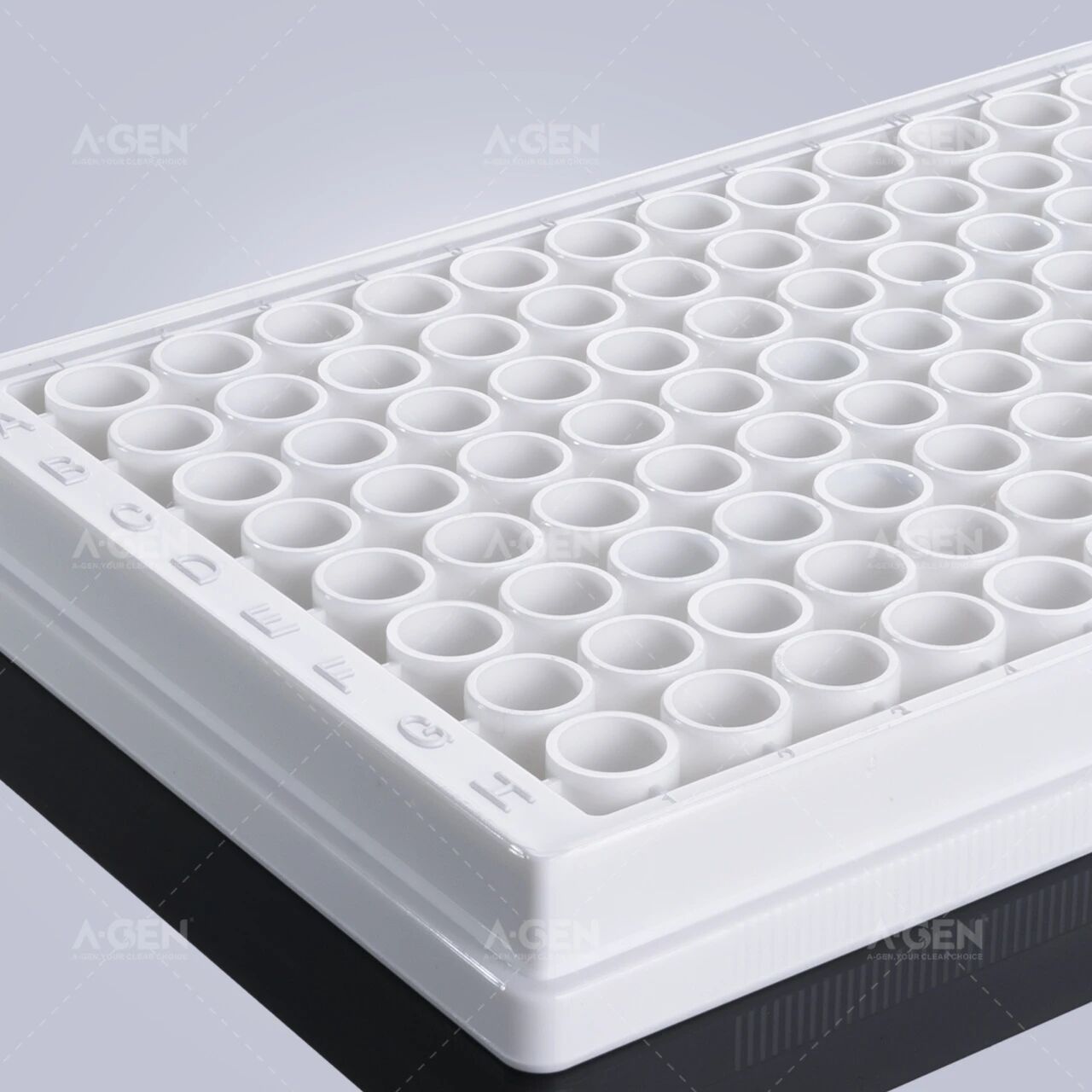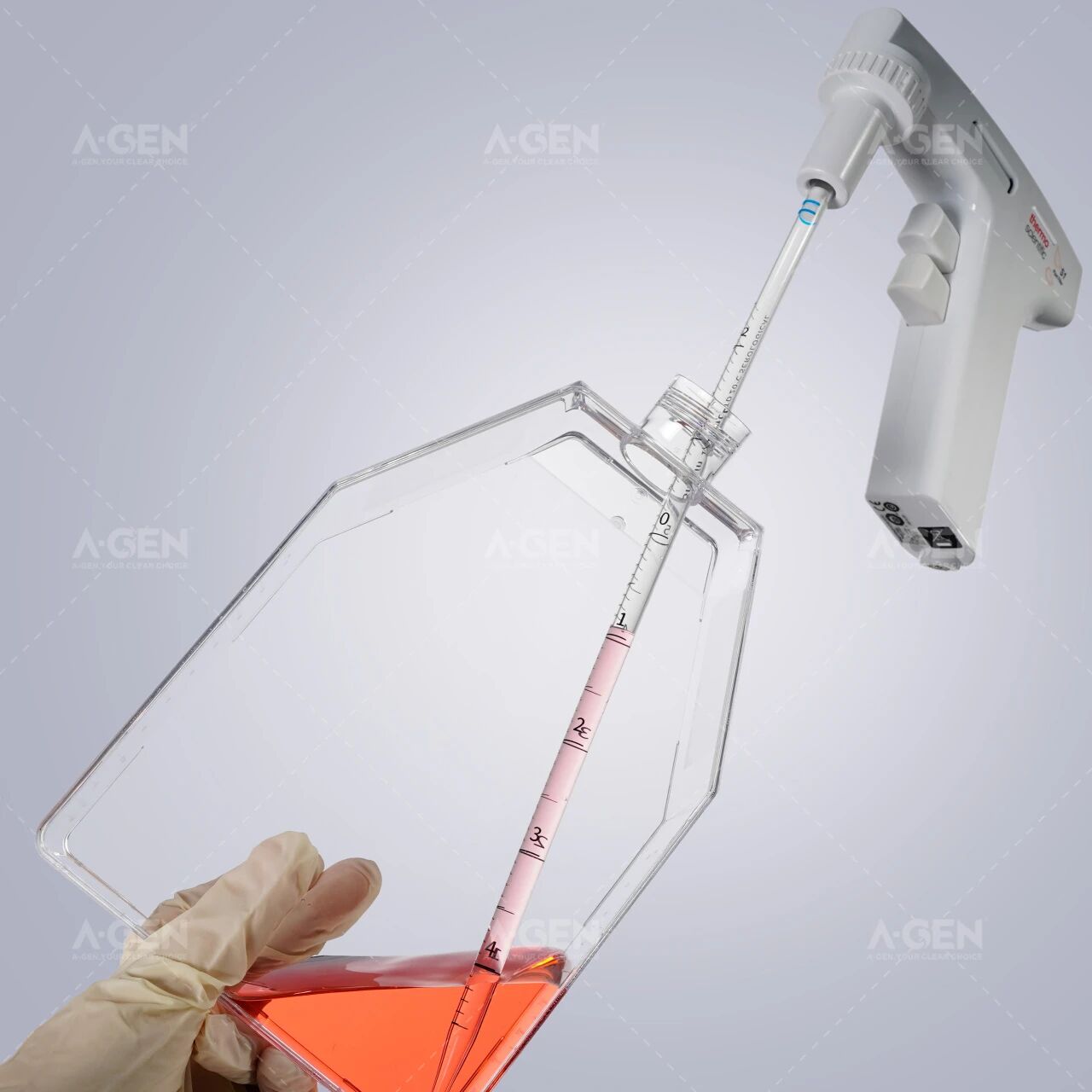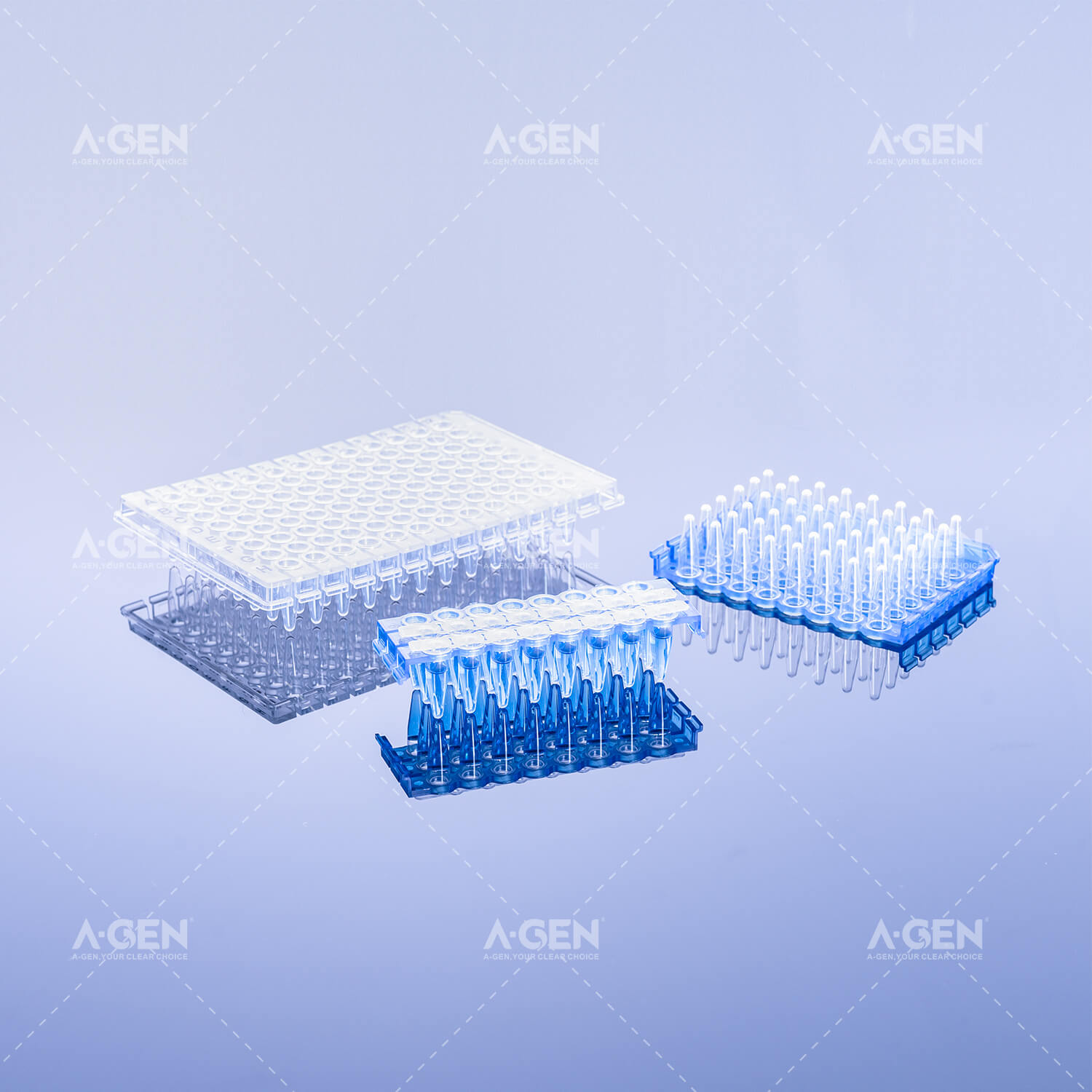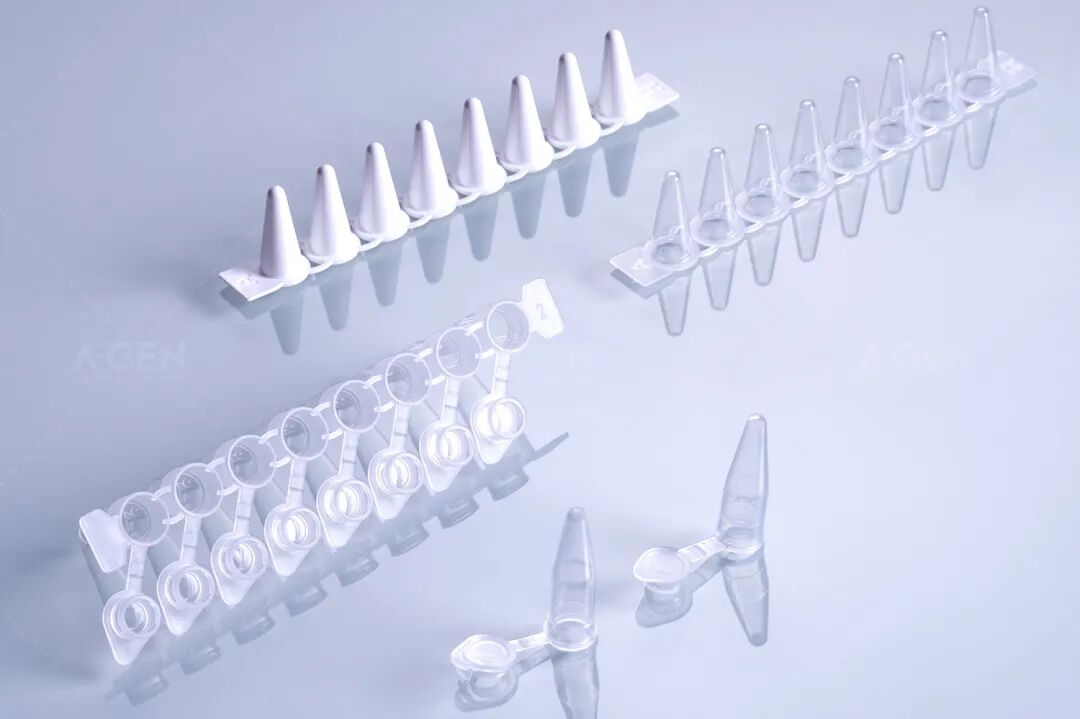
The best pipette tips for viscous liquids depend on the failure you need to correct. Choose low-retention tips when liquid remains on the tip wall, wide-bore tips when a narrow opening restricts flow or may stress the sample, and a positive-displacement system when a highly viscous liquid remains unreliable with an air-displacement pipette. Tip selection helps, but aspiration speed, pause time, temperature and validation determine whether the complete method is repeatable.
Why do viscous liquids cause pipetting errors?
An air-displacement pipette moves an air cushion between its piston and the sample. A viscous liquid responds more slowly than water, so it may still be entering the tip after the operator has released the plunger. Withdrawing the tip too soon can therefore aspirate less than intended.
Dispensing creates a second challenge. A sample may leave a film on the inner wall or remain near the tip opening. Fast plunger movement, insufficient pause time, air bubbles and uncontrolled immersion depth can increase the variation.
Temperature is another method variable. Because viscosity changes with temperature, a chilled reagent may behave differently after it has been on the bench for part of a run. Validate the transfer under the same temperature conditions used in the actual protocol.
When should you select low-retention pipette tips?
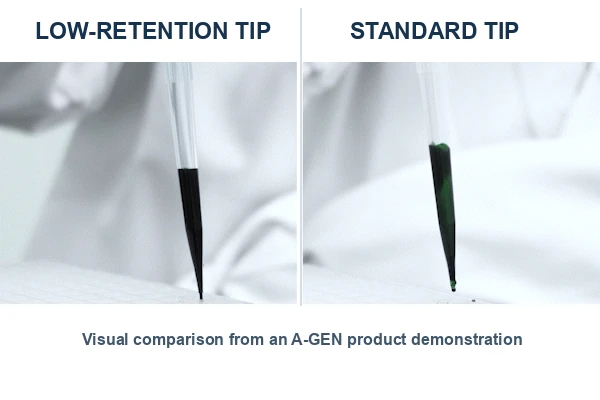
Low-retention pipette tips are the first option to evaluate when the sample visibly coats the inside of a standard polypropylene tip. Reducing surface adhesion may improve recovery and make the residual film more consistent.
Low retention does not remove flow resistance. If the liquid is entering the tip too slowly, the operator still needs a slower aspiration and a defined pause before withdrawal.
The label also needs a test boundary. Before purchase, ask the supplier what liquid, volume range and measurement method support the low-retention claim. Compare the candidate with the intended sample or a representative matrix rather than assuming that one surface performs the same way with every viscous formulation.
When is a wide-bore tip the better choice?
A wide-bore pipette tip provides a larger opening, which can reduce resistance during aspiration and dispensing. It may also be appropriate when a narrow orifice could damage cells, long DNA molecules or other shear-sensitive material.
The tip must still seal correctly on the pipette and operate within the required volume range. Do not create an improvised wide-bore tip by cutting a standard tip. Cutting changes the geometry, makes openings inconsistent and can introduce particles or contamination.
If sample protection is the reason for selecting a wide bore, validate both the delivered volume and the relevant biological outcome. A smoother-looking transfer does not by itself demonstrate improved recovery or sample integrity.
When should you use a positive-displacement pipette?
For highly viscous liquids, the limitation may be the air-displacement principle rather than the disposable tip. A positive-displacement pipette uses a piston that contacts the liquid inside a dedicated capillary or tip, reducing dependence on an intervening air cushion.
This can make positive displacement a stronger option when viscosity, density or vapor pressure causes conventional pipetting to drift. It is a system decision: the instrument, compatible consumable, volume range, operator training and running cost all need evaluation.
For occasional, noncritical transfers, an optimized air-displacement method may be sufficient. A routine assay with tight acceptance limits may justify a dedicated positive-displacement workflow.
Do filter tips improve viscous-liquid handling?
Filter tips are selected to reduce the risk of aerosols or accidental liquid reaching the pipette. They support contamination control but are not a treatment for viscosity.
Some workflows need both a filter and a low-retention surface. Evaluate that exact combination because filter location, tip geometry and working volume can affect the transfer. Do not treat `filtered` and `low retention` as interchangeable specifications.
Which tip volume and length should you choose?
Select a pipette and tip that place the target volume comfortably within the specified working range. Method sensitivity often becomes more visible near the extreme end of a range, especially when aspiration is slow or residue remains after dispensing.
Tip length should match the source vessel and required immersion depth. A long tip may improve access to a deep vessel, but excessive immersion can coat the outside and increase carryover. Nominal capacity alone is therefore not enough for selection.
Confirm the pipette model, tip fit, volume range, bore, cleanliness specification, sterility requirement, packaging format and lot traceability before approving a candidate.
How should you pipette a viscous liquid?
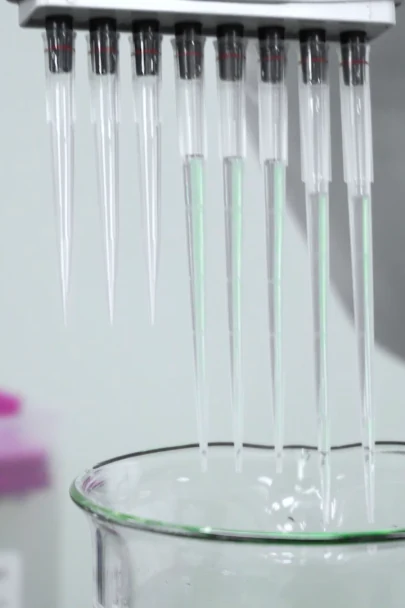
Begin with the current instructions for the pipette and tip, then standardize the variables that operators can control:
1. Keep the sample, pipette and tips at a stable, method-appropriate temperature.
2. Attach the tip consistently and confirm the seal without excessive force.
3. Aspirate slowly with the pipette close to vertical.
4. Immerse the tip only far enough to avoid drawing air.
5. Hold the plunger position for a defined pause before withdrawing the tip.
6. Check for bubbles and liquid on the outside of the tip.
7. Dispense slowly against the vessel wall when the protocol permits it.
8. Standardize the post-dispense pause and tip-withdrawal motion.
Pre-wetting can improve consistency in some methods, but it adds contact cycles and may be unsuitable where carryover or limited sample volume matters. Use it only when the procedure allows it and keep the number of cycles consistent.
Reverse pipetting can help with some viscous or foaming liquids. The operator aspirates excess liquid, dispenses the intended volume to the first stop and leaves a residual amount in the tip. Because the exact operation varies by pipette, follow the instrument instructions and document the method in the SOP.
How can you validate pipette tips for viscous liquids?
Test the complete pipette-tip-liquid-method combination. A fit test only shows that the tip attaches; it does not demonstrate accurate delivery.
Record the liquid, temperature, pipette model, tip type and lot, volume setting, technique, aspiration and pause times, operator and number of replicates. Compare bubbles, visible residue, delivered mass, repeatability and any relevant downstream assay result.
Gravimetric evaluation can be useful, but mass-to-volume conversion must account for the sample density and evaporation. Water calibration alone does not prove performance with a different liquid.
Include more than one operator and, where risk justifies it, more than one tip lot. A method that works only for the person who developed it is not ready for routine use.
Quick selection guide
| Observed problem | Option to evaluate first | Important limitation |
|---|---|---|
| Liquid coats the inner tip wall | Low-retention tip | Does not solve slow aspiration by itself |
| Thick liquid moves poorly through the opening | Wide-bore tip | Must still fit the pipette and volume range |
| Air-displacement results remain biased or variable | Positive-displacement system | Requires compatible instrument and consumable |
| Aerosol or pipette contamination is the concern | Filter tip | Filter does not reduce viscosity |
| Results vary between operators | Standardized timing and SOP | A new tip alone may not correct technique variation |
The best pipette tipsfor viscous liquids are the ones that address the observed failure mode and remain repeatable under real working conditions. Prepare the liquid type, target volume, pipette model, vessel format, cleanliness requirements and acceptance criteria before requesting a recommendation or sample evaluation.